Showing posts with label Realtor. Show all posts

Thursday, 11 February 2016

Bonnie Hart | Crucial Tips to Buying and Selling Real Estate

The key to making a smart residence is to know the facts. There are a lot of things to take into consideration before either buying residence or selling the residence you already have. This can be overwhelming to some, so here are the three most considerations to remember when it comes a chance to invest in or offer your financial commitment properties.

First, you need to have a great firm grasp on what the economic system is doing in your specific place. For instance in North West Illinois, house values have plummeted to surprising lows. This is a great thing for perspective home owners. Buy low and selling high. With the surrounding towns continuing to grow and develop, stabilization for the North West Illinois place economic system is not far off in sight. With all the extended tax credits, empty and rock bottom costs, it has never been a better a chance to make your home move Bonnie hart is a famous real estate specialist having long record of successful national and multi-national clients with their commercial real estate acquisitions Bonnie hart is a famous real estate specialist having long record of successful national and multi-national clients with their commercial real estate acquisitions. Bonnie hart has specialized in applying her knowledge and industry knowledge to broker commercial office, industrial, retail and multifamily properties that consistently exceed the investment goals of her clients. Clients choose to work with Bonnie hart for her services firm, ethics, experience and expertise.


Second, you need to have an excellent strategy established with a set amount of money you are planning to invest. This will make searching and finding your dream house much easier to narrow down and execute. With the costs of homes at a record low, setting a lower budget and adhering to it, is much easy to do. Setting a budget and adhering close to it sounds simple enough, and with the help excellent strong residence reflection by a knowledgeable professional, becoming a smart residence customer is very accomplishable. This brings us to the last but most essential key to buying a house. Bonnie hart regularly showed the ability to satisfy clients in the buying and selling of their home. Her strong base of loyal customers is the reason. 



Lastly, You need excellent consumer's reflection. There are many different kinds of reflection to get these days, but for your home customer, particularly a new residence customer, a Buyer’s Broker is the way to go. A Buyers Broker symbolizes the consumer's passions at no cost to the customer. An average residence broker, or a list agent, symbolizes owner and tries to get the highest price for owner. This is why picking your reflection is extremely essential. Of course, if you are selling your house, you would go with a typical residence broker with higher knowledge of the region you are working with. Bonnie hart has been so successful fir ever twenty years in the incredibly competitive sales environment. A record agent should have the tools to get you the most for your residence with the economic system today. You want someone with your passions in mind. It is necessary distinguish clearly between the two distinct types of residence reflection so that you, the residence customer, or supplier, gets the very most out of your residence.

Sunday, 8 November 2015

The real estate deals where money could not buy happiness


THEY say a man’s home is his castle.

Tear-jerking scripts have been written about the David and Goliath struggle between the humble homeowner and big business, but the classic tale behind films like The Castle and Up really do happen.

Known as “nail houses” after a Chinese expression that translates as “stubborn nails” the term was coined by developers in China who consider holdout homeowners as nails which can neither be pounded down into the wood, or removed.

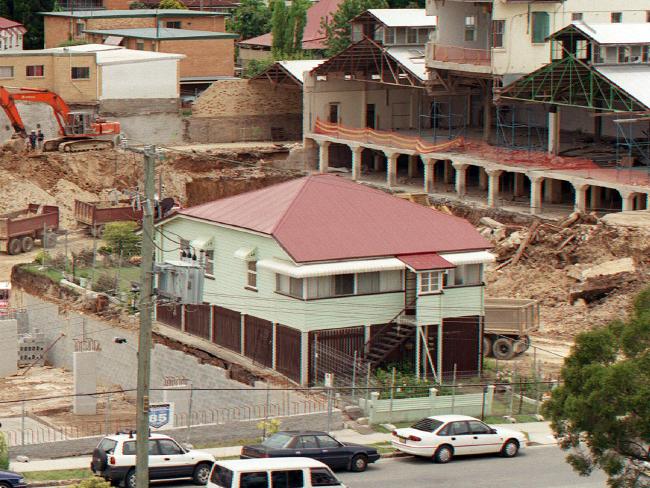
Fifteen years ago Norman and Janet Richards refused to give up their three-bedroom home when developers came knocking — even when they got out their fat cheque books.

But now after the passing of Mr Richards, and Mrs Richards’ move into a retirement home, 42 Mollison St will finally be sold to the highest bidder on November 18.
In 2000 the work began, but the Richards stayed put. Picture: Hanson Jamie

Australia’s own ‘Up’ house was put on the market last month and has since attracted a lot of attention according to selling agent Chris Kazonis of Drakos Real Estate.

“The interest has been interesting,” he told news.com.au, adding that everyone from homeowners to developers and restaurateurs have been calling.

“But people are pretty coy about just how much they’ll be willing to pay for it,” he said.

Mr Kazonis said there is nothing else quiet like it in the neighbourhood so it is difficult to price.

“We just don’t have any direct comprables,” he said.

According to RP Data Core Logic figures, the median sale price for a house in South Brisbane is $1 million.

The humble home is sandwiched between a shopping complex, which houses a Coles supermarket and 25 speciality shops on one side, unit blocks on the other and parking underground.

St Leonards, Sydney

For decades St Leonards on Sydney’s North Shore has been a pot pourri of apartment blocks and office towers, but one pint-sized property stood out from the developed crowd.

Sitting on a tiny 223sq m block, 19 Chandos St was the home of a family-run jewellery business John Clarke & Son for more than 75 years.

When the owner decided to wind up the business earlier this year, the single-storey residence was listed on the market with price expectations of about $3.5 million. It was bought by the family back in 1960 for 3000 pounds.

The unique property failed to sell under the hammer after in June, but has since been sold for an undisclosed sum.

 
This Content was originally posted on: Kirsten Craze

Tuesday, 13 October 2015

Real estate industry insiders say property prices look set to fall


BUBBLE IS ‘BLATANTLY OBVIOUS’

Lindsay David, founder of LF Economics and author of Australia: Boom to Bust, said all the data showed it was “blatantly obvious [that] Australia has one of the largest housing bubbles in modern Western history”.

“APRA since its inception has done nothing to stem the insanely rapid sums of debt Australian households have accumulated which now stands at 120 per cent of GDP,” he said. “This is simply an insane figure.”

Mr David said his research suggested the major banks were setting their mortgage teams incredibly high growth targets, and that the regulator’s recent macroprudential rules introduced in a bid to slow investor loans had simply shifted banks’ focus back to lending “irrational sums of debt” to owner occupiers.

“When you dive into the mortgage books and balance sheets of our major banks who have been lending to homebuyers like there’s no tomorrow, they resemble a toxic dump of debt with hardly a shred of capital to cover a significant fall in house prices or mortgage defaults,” he said.

The reality, he said, is that Australia’s banking system created too many artificial property buyers through rapid mortgage debt growth.

“History tells us it doesn’t matter how many new dwellings a nation builds, when leveraged speculation if rife, there will always be more buyers than sellers in the housing market followed by the complete opposite occurring,” he said.


WHAT DOES THAT MEAN FOR YOU?

Don’t panic, because this is normal.

That’s the message from Tim Lawless, senior analyst at property data firm Core Logic.

“Property values do go backwards, we’ve demonstrated that plenty of times in the past,” he said.

“In fact the past correction, between October 2010 and June 2012, we actually saw values fall by about 7.4 per cent (at a capital cities level), which is about what Macquarie Bank is saying right now,” he said.

“I think a 7.5 per cent fall is probably a reasonable expectation when you look back through history,” he said.

“We’ve already seen the housing market go through a really strong growth phase for nearly three and a half years now. That’s quite a long growth phase and normally you wouldn’t expect to see prices grow at this pace for so long,” Mr Lawless said.

He said particular markets across the country that are more exposed to a downturn in property prices are the area where there has been the most price growth and where conditions have been “imbalanced”.

Rather than talk of bubbles bursting, Mr Lawless said those markets which have been booming in recent years will see a price “correction”.

“During periods when values have gone backwards, they generally haven’t gone backwards by a substantial amount,” he said.

“I’d say that if the past is anything to go by, and this is what we’ve got to look forward to, we will see some falls in the larger capital cities, particularly in Sydney and Melbourne because we have seen values grow at a substantial pace compared to incomes and rents. It makes sense that values will rebalance themselves,” he said.

Mr Lawless said while the big “macro” market numbers are favoured by banks, househunters should look closer to home.

“I think they need to look at their own plans. For anyone who’s looking at holding their home for a long time, if they’re buying a principal place of residence and are expecting a long tenure there then it’s not that big a deal to get the timing right,” he said.

“But if you are an investor, or if you’re looking at potentially selling it in relatively short space of time, then the timing becomes a lot more important,” he said.

“At an individual suburb level, and down towards the micro areas of a neighbourhood, there are always going to be different opportunities and different challenges in the market. So it’s up to individual buyers to really nut out what the conditions are like below that capital city boundary and look at what’s happening in the particular markets,” he said.
PRICE CRASH NEEDS A TRIGGER

Leading economist Saul Eslake played down the immediate danger of a large fall in house prices. For that to happen, he said, there would need to be a combination of a significant number of forced sellers through mortgage defaults and an oversupplied market.

The first is unlikely due to low interest rates which are likely to remain so for some time, and relatively large buffers built up by mortgage holders who have taken advantage of those low rates.

“I don’t think there is any immediate danger of a significant fall in house prices — 7.5 per cent is remarkably precise and you’re brave to be that precise in forecasts about the housing market,” Mr Eslake said.

He argued even though house prices might be overvalued, that didn’t mean they’re going to fall in the same way as stocks. With home ownership still at around 67 per cent, the majority of people own property to live in.

“I can accept that housing looks overvalued by various metrics, but that of itself isn’t the issue,” he said. “Asset prices are almost always overvalued or undervalued — the proportion of time that any asset is exactly at fair value is very small — but that doesn’t necessarily mean they will fall. Something has to happen to trigger that.”

Mr Eslake has previously predicted the probability of Australia falling into recession in 2015 or 2016 as the mining boom unwinds at around 25 per cent. He said the recession danger doesn’t come from house prices per se, but from homeowners forced to save more to pay off their mortgages, slowing consumer spending.

“The biggest risk is not to the financial system, because Australian banks are fairly well capitalised, and Australians have been historically reluctant to default on mortgage debt. It’s what they do to reduce the chances of that happening,” he said.

AMP Capital chief economist Dr Shane Oliver is tipping a 5-10 per cent fall, but more likely some time in 2017, and only if the RBA hikes rates. “My feeling is we’re on a period of deceleration, where prices continue to rise but at a much slower rate,” he said.

He pointed out that the so-called housing boom has only really been in Sydney and Melbourne, with half the capital cities already in decline, but particularly Perth and Darwin.

Dr Oliver said he puts the likelihood of recession at just 20 per cent. “The biggest worry is housing approvals are at very high levels, up around record levels recently, but it’s the momentum that counts,” he said.

“If they top out or go sideways, which looks likely, then the contribution to growth from housing construction will fall back to zero over the next 12 months.”


This Content was originally posted on: Kirsten Craze

Tuesday, 6 October 2015

Perth house prices fall, properties for rent up: REIWA data

Perth house prices have fallen again but rents have also dropped in the September quarter.

PERTH house prices have fallen another $15,000 in the September quarter and there are now more 50 per cent more rental properties on the market than this time last year.  

New data from the Real Estate Institute of WA shows the median house price dropped by 2.7 per cent in the September quarter to $535,000.

REIWA deputy president Hayden Groves said the price adjustment of 2.7 per cent was quite modest given the high number of properties on the market.

“Currently we have almost 15,000 listings on the Perth market, which is up by about 3,000 on what we would consider normal,” Mr Groves said.

Sales turnover was down by about 14 per cent from the previous quarter.

Only a handful of areas saw an increase in turnover for the quarter, but these included Fremantle, Gosnells, Cockburn and Armadale.

Top selling suburbs overall included Butler, Ellenbrook, Bayswater, Baldivis and Canning Vale, largely reflecting first homebuyer activity.

There are also 8311 rental properties on the market — up 50 per cent from the same time last year.

The vacancy rate has now lifted to 5.4 per cent — its highest figure since 1996.

“As a consequence, the overall median rent has dropped to $410 per week across Perth, and is now typically around $420 for a house and $395 for a unit, apartment or villa,” Mr Groves said.

Stronger quarterly falls in rent were found through the City of Fremantle, down $30 to $465, and the City of Belmont, down $25 to $400 per week.  


This Content was originally posted on: ANNABEL HENNESSY